Nocturnes book published by Museo Correr

EXHIBITION CATALOG CELEBRATES "DIALOGHI CANOVIANI: NOTTURNI DI KAREN LAMONTE"
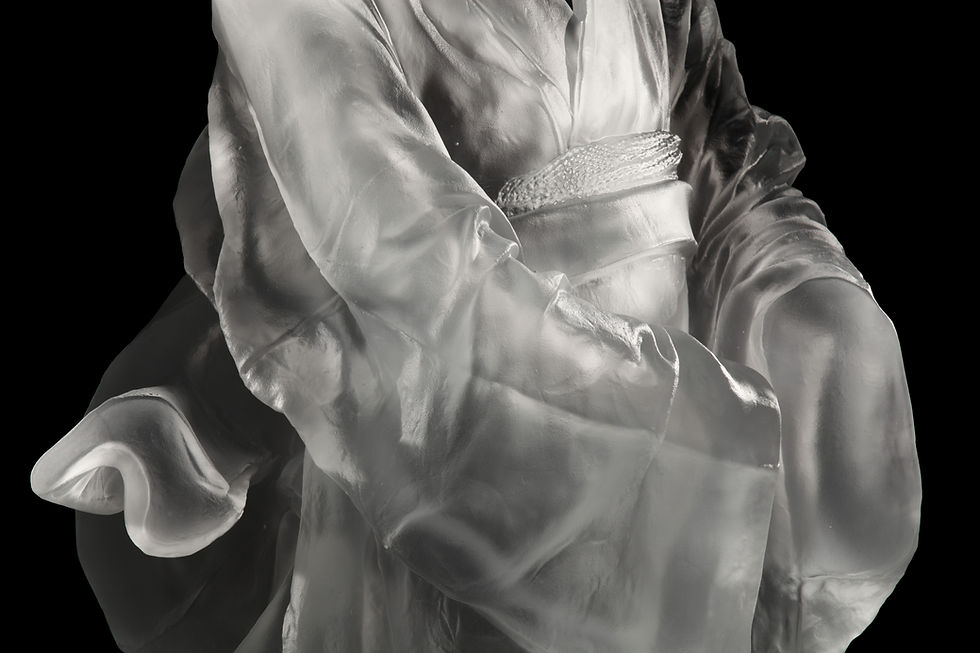
From October 2025 through February 2026, four of Karen's glass Nocturnes were displayed with Neoclassical marble masterpieces by Antonio Canova. The exhibition was at Venice's Museo Correr where the artists' works were in silent conversation with each other, connecting past and present through sculpture.
Museo Correr and Fondazione Musei Civici di Venezia published a beautiful catalog celebrating the first-of-its-kind exhibition with thoughtful essays by several notable writers:

Luigi Brugnaro, Mayor of the Metropolitan City of Venice
Mariacristina Gribaudi, President of the Fondazione Musei Civici di Venezia
Andrea Bellieni, Director Museo e Biblioteca Correr / Director Correr Museum and Library
Chiara Squarcina, Scientific Director, Fondazione Musei Civici di Venezia; also curator
Eraldo Mauro, Curator; exhibition design and coordinated image
"Within the folds of the draped forms that envelop this imagined physicality, the full narrative poetry of Karen LaMonte emerges, in profound harmony with Canova’s own expressive paradigm. The overall result is a striking convergence of aesthetic reflections, made possible by the enduring legacy of Canova and by the formal and conceptual talent of Karen LaMonte."
— Luigi Brugnaro, Mayor of the Metropolitan City of Venice


"Certainly, LaMonte’s work is not untouched by classical art or by Canova’s Neo-classicism (as a recent catalogue has explicitly observed). Yet if in Canova the perfection of execution breathes life into inert matter, in LaMonte the same perfection serves instead to evoke a possible life—to suggest it, to create the conditions from which such a life might emerge. A comparison, then, between two visions of art that appear similar yet are, in truth, opposed: one grounded in description, the other in deduction."
— Eraldo Mauro, Curator; exhibition design and coordinated image
"The art of Karen LaMonte unites culture and glass in an unprecedented symbiosis. The transparent mass is selected and shaped to lend soul to works that deliberately delineate the outer shell while withholding the essence within. Hers is an expressive language that carries classicism—known to us for its idioms of abundant drapery and commanding grandeur—into a world that is solid yet, in an ideal sense, fluid ...
It is no coincidence that Canova’s works have been placed in dialogue with hers: an opportunity to trace connections and resonances linking works from different eras and fashioned from different materials, yet all striving towards a paradigm founded on beauty."
— Chiara Squarcina, Scientific Director, Fondazione Musei Civici di Venezia; also curator